Callback




Prof. Dr. Yossi Harpaz is Associate Professor of Sociology at Tel Aviv University in Tel Aviv, Israel.
Citizenship is the key status that determines a person’s position in a hierarchical global system. Those who are born with the ‘right’ citizenship — say, Canadian or Swedish — gain access to a formidable package of opportunities, rights, and security that is nearly unimaginable to persons born with, say, Somali or Syrian citizenship. Only about 15% of the world’s population holds citizenship from the European Union or other highly developed countries: Australia, Canada, Japan, South Korea, or the USA. Relative to the remaining 85% of humanity, they are a global elite in terms of citizenship rights. The gaps between the highly developed, mostly Western countries and (almost all of) ‘the rest’ are vast: the economist Branko Milanović has calculated that the 5% of Americans with the lowest incomes still have an average income that is higher than 60% of the world’s population (they are in the 60th percentile of the global income distribution). Meanwhile, the earnings of the lowest-income Danes place them in the 90th percentile of the global distribution of incomes.
The elite status of Western and European Union citizenship becomes even more striking when we take into consideration its extraterritorial value — that is, the recognition that these passports receive in countries other than the countries that issued them. This perspective reveals a vast disparity in global travel freedom. For example, Spanish citizenship offers a package that (through European Union citizenship) also includes an unrestricted right to reside and work in member states Germany or Sweden, and visa-free or visa-on-arrival access to Canada and the USA. Travel freedom has become particularly valuable in today’s globalized world, where the ability to cross international borders plays a key role in determining individuals’ economic opportunities, consumption habits, and social status — sometimes even their personal safety.

We can view citizenship, then, as a sorting system that allocates individuals into different, and starkly unequal, slots within a global matrix of states and citizens. For most of the 20th century, this sorting system did not tolerate overlaps: countries demanded exclusive allegiance from their citizens and typically did not permit multiple citizenship. In 1990, only about a quarter of countries in Europe and the Americas permitted dual nationality. Soon thereafter, legal norms rapidly began to change. Numerous factors, including a boost in international migration and the end of the Cold War, have combined to make dual citizenship legally and normatively acceptable. By 2016, more than 80% of countries in Europe and the Americas permitted dual citizenship. Precise, country-specific figures for Africa and Asia were unavailable, but countries on these continents follow the same overall trend (albeit at a slower pace). Today, the acceptance of multiple citizenship is becoming the global norm, at least in democratic countries.
On the other hand, the ongoing global conflict is reigniting some of the old security concerns about dual citizenship, pushing many countries to adopt more restrictive policies. Russia has tightened restrictions on dual citizenship while Ukraine outright bans dual citizenship with Russia. Finland and Sweden recently made it easier to strip citizenship from dual nationals convicted of disloyal acts. For now, most other Western European nations abstained from adopting such measures (Germany even made a liberalizing move in 2024). However, restrictive shifts are expected if rightwing, anti-immigration parties come to power in countries like France or the Netherlands. Both Marine Le Pen and Geert Wilders support placing restrictions on dual nationals and making it easier to strip them of citizenship.
Figure 1. Percentage of countries per region that permitted dual citizenship (1990, 2016)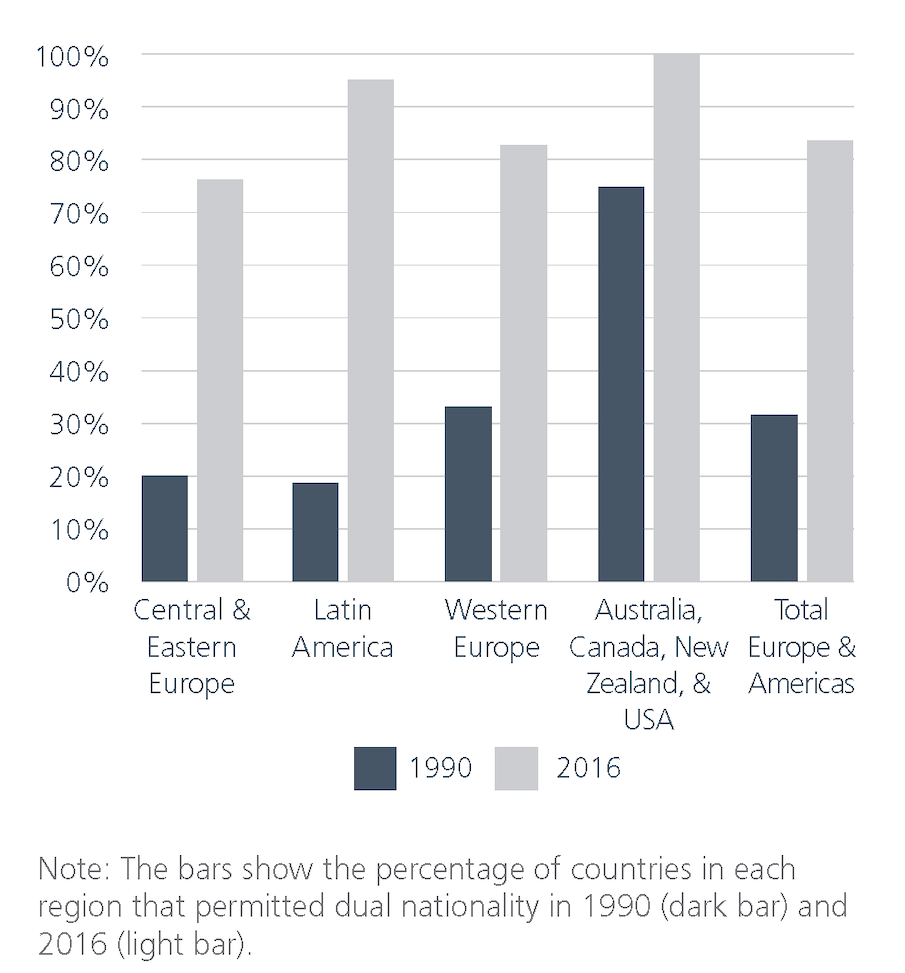
Source: Reproduced from Y. Harpaz, Citizenship 2.0: Dual Nationality as a Global Asset (Princeton University Press 2019)
Even with those hiccups and reversals, the widespread acceptance of dual citizenship is a solid fact (at least for now), one that carries far-reaching consequences. The willingness of so many countries to waive the traditional requirement for exclusivity has the potential to change the basic ways that states and individuals approach national membership. As citizenship becomes more flexible, many states now extend citizenship to populations that live outside their territories but are nonetheless desirable for other reasons — because of their ancestry or ethnicity, or even because of their value as potential entrepreneurs and investors.
From the point of view of individuals, the change is even more dramatic. In the ‘traditional’ system of exclusive national membership, citizenship operated as a strict, rigid status: once assigned (usually at birth), it could be changed only with great difficulty. Acquiring a second citizenship typically entailed giving up the original one. Once it is possible to hold more than one citizenship, all this changes. Citizenship is now flexible and fungible. In sociological terms, citizenship is changing from being an ‘ascribed status’, meaning a characteristic that is fixed and imposed from the outside, to an ‘achieved status’, meaning that it can be changed through individual striving. People around the world can strategically plan their citizenship status and seek the national affiliation that they believe would provide them with the greatest benefits for the smallest investment. Although only a very small percentage of humanity has done this, the fact that such strategies are now possible leads to changes in the value and meaning of citizenship. Citizenship is being drawn into the capitalist market and is coming to be perceived as a piece of private property — even a commodity.
The new principle of dual citizenship toleration — and the concomitant commodification of citizenship — adds dynamism to the rigid system of citizenship-based global inequality, providing new ways for people to improve their position in the global hierarchy. The clearest expression of this is a phenomenon that I call compensatory citizenship: individuals from outside the West who obtain a second citizenship from a Western or European Union country. The second, premium citizenship is ‘compensatory’ because it is typically used to complement the primary, resident citizenship rather than replace it. Most individuals who obtain this kind of citizenship do not emigrate; instead, they are interested in securing an ‘insurance policy’, a premium passport and improved opportunities that their primary, resident citizenship cannot offer them.
Compensatory citizenship is usually found in countries that are in the middle of the global distribution of citizenship value and that host populations with a history of ancestral, ethnic, or migration ties with European and North American countries. This applies first and foremost to two regions: Latin America and Eastern Europe. When Italy and Spain offered dual citizenship to the descendants of emigrants, almost a million Argentinians and Brazilians applied for a second passport. In Eastern Europe, citizens of non-European Union countries rush to secure co-ethnic citizenship from the countries that have joined the Union. Thus, hundreds of thousands of Moldovans, Serbians, and Ukrainians have secured citizenship from countries such as Hungary and Romania. In contrast, eligible individuals in Western Europe and the USA showed relatively little interest in converting their roots into a second citizenship — until recently. This demonstrates that the main force driving the demand for ancestry-based European citizenship is the wish to overcome the limitations associated with one’s original citizenship.
The theory of instrumental, compensatory citizenship is further reinforced by the recent emergence of interest in dual citizenship in two leading Western countries: the UK and the USA. As long as the UK was a member of the European Union, interest in dual citizenship was negligible. Following the 2016 Brexit vote, however, there was a surge in interest in ancestry-based citizenship from a range of European countries, including Ireland, Germany, Spain, and others. Acquiring European Union citizenship was clearly intended as a means to regain the mobility that British citizens lost post-Brexit.
Even more interesting is the case of the USA. While it remains a highly prosperous country and a magnet for immigrants, America has been suffering from social and political polarization and instability. Since around 2020, thousands of Americans have sought to acquire ancestry-based citizenship from their countries of origin, including Ireland, Italy, Mexico, and Spain. Some of them use the second citizenship to move abroad while others — presumably the majority — mainly desire a ‘plan B’ for a rainy day.
As millions of European descendants convert their ancestry into privileged access to the European Union, individuals who do not have such ancestry are coming up with other methods to secure compensatory dual citizenship. One strategy is ‘birth tourism’: traveling to the USA and giving birth there with the aim of providing the newborn with automatic birthright citizenship. Given the expenditure involved in birth tourism — starting from USD 7,000 and ranging up to USD 25,000 or more — it is mostly practiced by wealthy families coming from a range of origin countries, including China, Mexico, Nigeria, and Türkiye. The USA is not alone in attracting birth tourists: thousands of Russians travel to Brazil and Argentina — countries that also have birthright citizenship — to give birth there. Furthermore, the current US government is actively seeking to restrict automatic birthright citizenship, although their chances of success remain uncertain. Other pathways to compensatory citizenship include strategic naturalization (naturalizing in a destination country and then returning to one’s origin) as well as the acquisition of citizenship by investment.
These developments lead to changes in the way people around the world understand and experience citizenship. I have conducted research on three study cases of compensatory citizenship: in Israel, Mexico, and Serbia. I will briefly present the Israeli and Mexican cases. The Israelis I studied were second- or third-generation immigrants who drew on their ancestry to obtain European Union citizenship (most commonly, citizenship of Germany, Poland, and Romania); the Mexicans belonged to middle- and upper-class families that practiced birth tourism in the USA. Despite the geographical, cultural, and historical differences between the two settings, I found striking commonalities in the ways in which people related to citizenship.
Until quite recently, these combinations of dual citizenship would be highly provocative and controversial. First, Mexico did not permit dual citizenship until 1998. Second, Mexicans traditionally condemned emigrants to the USA — especially those who took up American citizenship — as traitors or rotten persons (pochos). In Israel, dual citizenship was always permitted by law but there was a strong social stigma against seeking German citizenship. In the eyes of many Israelis, taking German citizenship was an abomination — a blasphemous act tantamount to ‘forgetting the Holocaust’ and repudiating Zionism. Today, such discourses still exist in both countries, but only at the margins. Even if the partner nation is a historical rival or victimizer, dual citizenship is seen as widely legitimate, and dual citizens generally face little everyday censure.
As for citizenship applicants themselves, in Israel and Mexico they typically employed terms associated with property and economic interests when discussing citizenship. Mexican parents spoke of strategic birth as a long-term investment in their children’s future. They calculated its costs against the expected benefits — above all, in terms of security, opportunities, and global mobility — while also considering associated additional costs (such as taxation). In Israel, the decision to apply for dual citizenship was often explained as a quest for restitution. Applicants commonly described German or Polish citizenship as an asset that was stripped away unlawfully from their immigrant parents or grandparents. Acquiring European Union citizenship through these countries offered a degree of restitution for the lives and property that their families lost in the Holocaust. As in Mexico, the second citizenship was envisaged as useful only to the younger generation — for whom it would supposedly provide ‘opportunities in Europe’ (not in the specific origin country) and even make them ‘citizens of the world’.
This last point helps explain the lowered public resistance to dual citizenship in Israel, Mexico, and elsewhere. Along with its ‘marketization’ and commodification, citizenship is also becoming denationalized, meaning that it is coming to be associated less with a specific nation and more with economic benefits and standing within a global society. This has been the dominant trend since the rise of globalization in the 1990s — will it persist into the late 2020s and the 2030s as global conflict looms?
Prof. Dr. Yossi Harpaz is an Associate Professor in Sociology at Tel Aviv University, Israel. He received his PhD in sociology from Princeton University. His research deals with contemporary changes in the institution of citizenship and their impact on global inequality and national identity.
His work has been published in The British Journal of Sociology, International Migration Review, the Journal of Ethnic and Migration Studies, and other journals. His first book, Citizenship 2.0: Dual Nationality as a Global Asset, was published in 2019 by Princeton University Press. This essay is based on the book’s main findings.



As the global leader in residence and citizenship planning, Henley & Partners is best placed to advise you and your family. Contact us for a free consultation.