Callback




As the world becomes increasingly digitized, more countries are implementing electronic travel authorities (ETAs) as a means of processing and screening travelers with visa-free access. One of the oldest and most established ETAs is the Electronic System for Travel Authorization (ESTA) in the USA.
Introduced in 2009, ESTA is a key component of the USA’s border security and immigration framework. It operates as an automated system that determines the eligibility of travelers to enter the country under the Visa Waiver Program (VWP). Rather than replacing a visa, ESTA functions as a pre-travel authorization, enabling US authorities to assess travelers before they arrive in the country.
From a US policy perspective, ESTA has two main objectives: to facilitate legitimate short-term travel and strengthen and support national security. It provides a streamlined alternative to a traditional visa process while enabling U.S. Customs and Border Protection (CBP) to identify potential risks and reduce the number of inadmissible individuals arriving in the USA.
An ESTA is typically valid for two years, or until the traveler’s passport expires, whichever comes first. During this time the traveler can make multiple trips to the USA for business, tourism, or transit purposes, for up to 90 days. Importantly, ESTA approval, as with any ETA, does not guarantee entry; it authorizes travel to a US port of entry, where border officers retain final discretion over admission.

ESTA is designed for travelers from countries that are visa exempt from the USA under the VWP. The VWP enables most nationals of participating countries to travel to the USA for tourism or business for stays of 90 days or less without obtaining a visa.
Individuals who have traveled to certain countries of concern, such as Cuba, Iran, Iraq, Libya, North Korea, Somalia, Sudan, Syria, or Yemen, or who hold dual nationality with any of the aforementioned countries, may be excluded from ESTA eligibility and instead be required to apply for a US visa. Similarly, travelers intending to work, study for extended periods, or remain in the USA beyond 90 days must obtain the appropriate visa, as ESTA is strictly limited to short-term visits.
In addition, individuals with prior immigration violations, criminal convictions, or previous visa refusals may be ineligible for ESTA, even if they hold a passport from a VWP country. In such cases, a formal visa application through a US embassy or consulate is required, allowing for a more detailed assessment of admissibility.
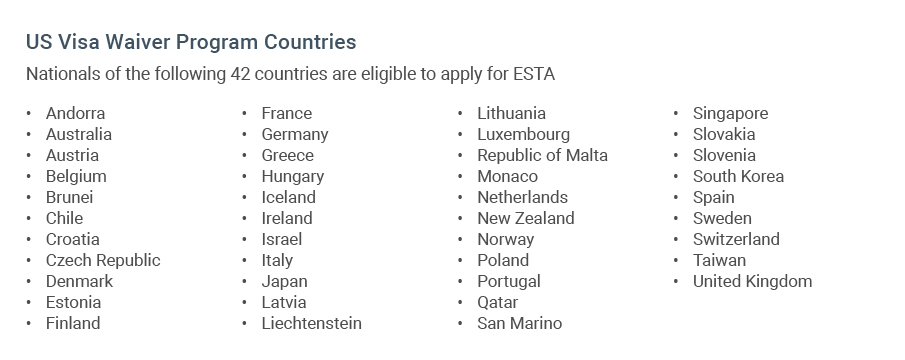
The current list of countries included in the US VWP is below:
ESTA applications can be made online through the official US government ESTA platform or through the official mobile app (available from App Store and Google Play).
The application process involves the following steps:
Applicants must provide biographical information as it appears in their passport, including full name, date of birth, and passport details. Travel-related information, such as the address of the first accommodation in the USA (if known), is also requested. In addition, applicants must answer a series of eligibility and security-related questions covering areas such as criminal history, health, prior immigration issues, and travel to specific countries.
Once the application is submitted, a processing fee of USD 40 must be paid electronically via credit card or PayPal.
The system conducts automated checks against multiple US government databases including security, immigration, and law enforcement systems. In most cases, applicants receive one of three responses:
If approved, the ESTA authorization is electronically linked to the applicant’s passport. Airlines are able to verify ESTA status directly before boarding, and travelers without valid authorization may be denied boarding.
On 10 December 2025, CBP published a 60-day notice and request for comments in the Federal Register proposing several significant updates to the ESTA application process, expanding the personal data requirements for applicants. According to the notice, the following changes have been proposed:
CBP is planning to add social media as a mandatory data element for an ESTA application and will require applicants to provide their social media information from the five years preceding their application.
CBP intends to add several data fields to the ESTA application, including:
CBP intends to update the ESTA application website to require applicants to provide a photograph of their face, or “selfie”, in addition to the photo of the passport biographical page.
In addition to the additional data requirements, the notice also outlines plans to move all ESTA applications onto the mobile app, making mobile the sole application option. The ESTA website would remain available as an information resource for the VWP program and as a tool for ESTA applicants to check the status of their submitted applications, but applicants would be required to use the ESTA mobile application to apply for ESTA.
There is also a plan to enable an optional self-reported departure tool. This would add functionality to the mobile app that enables travelers to document their departure from the USA by submitting a facial image and enabling geolocation.
The CBP is currently accepting public comment on the proposed changes, after which they are expected to be finalized and implemented in stages over the coming months.



As the global leader in residence and citizenship planning, Henley & Partners is best placed to advise you and your family. Contact us for a free consultation.