Callback




Numerous countries across Europe are gearing up to introduce two new border management systems that will impact on travel into Europe: the European Travel Information and Authorisation System (ETIAS) and the Entry/Exit System (EES).
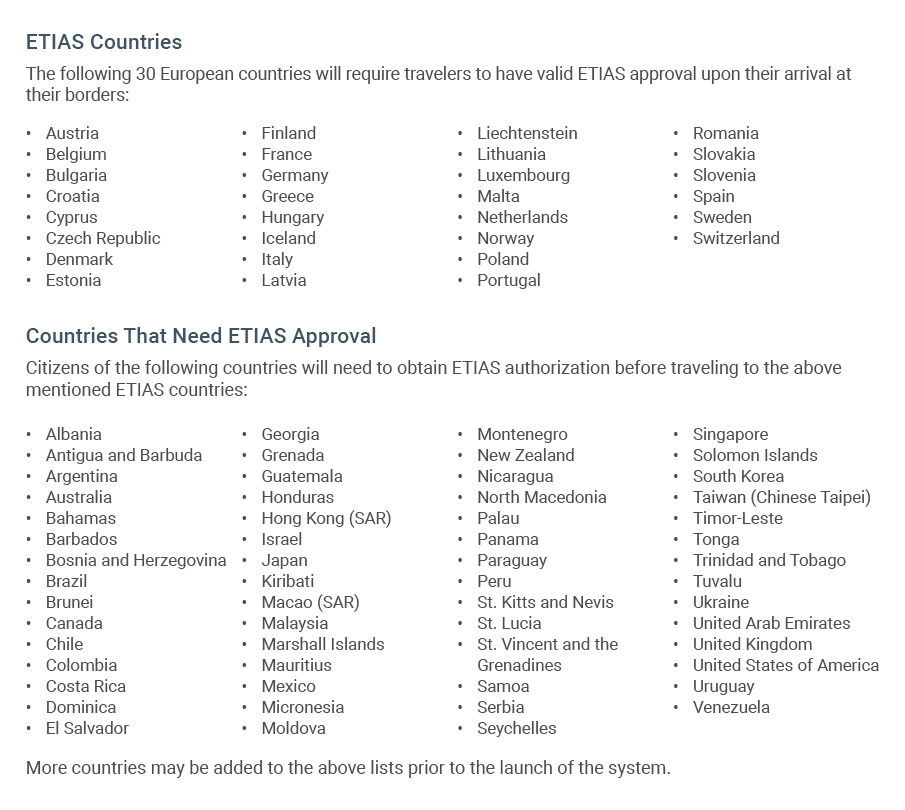
ETIAS is an electronic travel authorization system that is scheduled to be introduced in late 2026 to pre-screen and monitor the movement of foreign nationals who currently do not need a visa to travel to the 29 countries that constitute Europe’s Schengen Area, as well as Cyprus.
There have been numerous delays in implementing the system but when finally initiated, there will be a 180-day grace period before travelers will require ETIAS approval.

ETIAS is designed for travelers from visa-exempt countries who plan to visit these 30 European countries for short-term purposes such as business, family visits, tourism, or transit. It will not apply to travelers from countries that require a visa to enter the Schengen Area or Cyprus, as the visa acquisition process already includes the relevant screening.
ETIAS is similar to other digital entry systems already in place in several countries, such as the USA’s Electronic System for Travel Authorization (ESTA) and the Australia Electronic Travel Authority. Generally, these systems are referred to as electronic travel authorizations (ETAs).
Like other ETAs, the ETIAS travel authorization is not considered a visa. Rather the system is a pre-travel screening tool that will be mandatory for all travelers from visa-exempt countries wishing to travel to the 30 European countries listed above.
The ETIAS Application Process Will Include the Following Steps:
Online application: Travelers will apply through the official ETIAS website or mobile app. They can also nominate a third party to apply on their behalf through the website or app by mutually signing a declaration of representation. In order to apply, travelers must have a valid travel document that does not expire within three months. They will also need to provide personal details including contact information, education and current occupation, travel plans, and answers to basic security questions such as details about any criminal convictions, and past travels to war or conflict zones. No biometric data is collected.
Payment of fees: A nominal fee will be charged for processing the application, which must be paid online at the time of submission. According to the latest information, the fee is set at EUR 20, although some travelers will be exempt, including those under 18 or over 70 and family members of EU residents and citizens.
Approval process: Once the application is submitted, the ETIAS system will cross-references the traveler’s details with various databases and in most cases, applications will be processed and approved within minutes. If your application is denied, you will receive an e-mail stating why and explaining the appeal process.
Authorization: Upon approval, the authorization will be electronically linked to the traveler’s passport. Travelers will not need to carry a separate document, as border officials can verify the authorization via electronic systems.
An ETIAS travel authorization will be valid for up to three years or until the traveler’s passport expires, whichever comes first. During this period, it will permit multiple entries for short stays of up to 90 days within a 180-day period.
As a precursor to launching ETIAS, all participating European counties have introduced a new Entry/Exit System (EES) that functions as a digital passport check. This new system was implemented on 12 October 2025 and is being gradually introduced at all external borders with the aim of full implementation by 10 April 2026.
This automated system will require identity, travel document data, and biometric checks for all non-EU travelers arriving for a short stay.
The EES is distinct from ETIAS in several key ways:
ETIAS and the EES are ambitious, large scale, digitization projects that will transform travel and border management in Europe’s Schengen area. As border security and control becomes an increasingly prevalent topic across Europe, the systems will allow participating countries to leverage technology both to reduce security threats through the pre-screening process and to enable faster processing of larger volumes of travelers.



As the global leader in residence and citizenship planning, Henley & Partners is best placed to advise you and your family. Contact us for a free consultation.