Callback





Kevin Bürchler is Chief Executive Officer at SIP Medical Family Office, Zurich/Switzerland.
In a world where global mobility is reshaping how affluent families live, work, and age, the rising cost of private healthcare has become a defining — and often underestimated — strategic consideration. The SIP Health Cost Index 2025 reveals striking disparities in medical expenses across 50 countries, exposing how the USA, Asia’s medical powerhouses, and parts of Europe dominate the top tier of high-cost markets. For internationally mobile entrepreneurs and multi-resident families, these insights offer a critical lens into how healthcare access, affordability, and quality increasingly influence residence planning, lifestyle decisions, and long-term well-being.
Health-related costs and medical inflation vary significantly between countries, and the pattern and pace of change can differ dramatically. For mobile entrepreneurs, global citizens, and internationally connected families, understanding the implications and opportunities associated with accessing healthcare across borders is crucial to strategic decision-making. The SIP Health Cost Index 2025 benchmarks private healthcare cost expectations and reveals substantial disparities between regions, offering valuable comparative insights.
Existing measures of healthcare costs typically assess affordability from the perspective of the general public or rely on theoretical models. However, the needs of affluent families are distinctly different, centering on private healthcare, private insurance, and longevity-focused lifestyle services that are not adequately captured by traditional metrics.
The SIP Health Cost Index addresses this gap by using International Private Medical Insurance (IPMI) premiums as a proxy for the true cost of private healthcare in each country. IPMI is the only form of health cover that guarantees elective access to private medical care worldwide, regardless of jurisdiction. Its pricing is based on expected healthcare expenditure and individual risk profiles, driven primarily by the cost level of the policyholder’s country of residence and their age.
Because insurers hold detailed data on the actual healthcare costs incurred by privately insured individuals, IPMI premiums provide a far more accurate benchmark for high-net-worth and globally mobile families when comparing real-world health-related costs across countries.

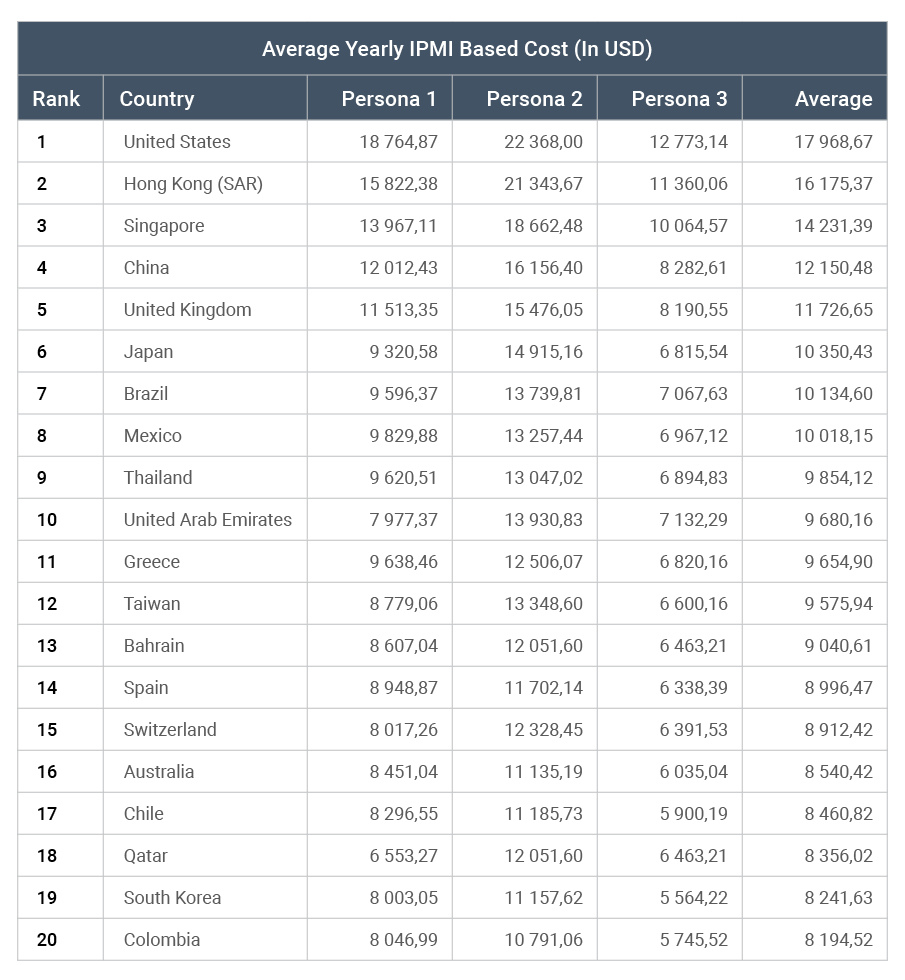
It comes as no surprise that the country with the highest healthcare costs is the USA. As a country with minimal state regulation of healthcare pricing, both international and local patients are familiar with the high degree of unpredictability and inconsistency in medical costs. In the absence of standardized pricing, patients must either rely on insurance providers — whose negotiated agreements determine the price of services — or attempt to negotiate bills themselves.
Hong Kong and Singapore rank as the second and third most expensive healthcare systems, respectively, and both are widely regarded as global centers of medical excellence. Perhaps more surprising is China’s position as the fourth most expensive country for private medical care. While everyday medical services and treatment in public hospitals are generally very affordable, accessing top-end private care at international hospitals is a completely different proposition — often matching or even exceeding the prices charged by the most expensive healthcare facilities in Europe.
China’s high ranking is further influenced by the significant number of patients who travel from mainland China to Hong Kong and Singapore to access higher-quality — and typically more expensive — medical services.
As the highest-ranked country in Europe, the UK is placed 5th among the most expensive healthcare markets in the index. Confidence in the public National Health Service (NHS) has been at an all-time low since 2024 due to long waiting times for day-to-day appointments, emergency services, and hospitalizations. At the same time, London is home to some of the most renowned and advanced private healthcare providers, including those concentrated in and around Harley Street.
Private domestic healthcare pricing, increased demand for outbound medical travel to destinations with shorter waiting times, and the 12% Insurance Premium Tax applied to all private health insurance policies are three key factors contributing to the high cost of private healthcare in the UK.
Surprisingly, Switzerland is ranked only 15th. The IPMI pricing that informs the SIP Health Cost Index does not take into account situations where a country’s domestic insurance system absorbs a significant share of healthcare costs. In Switzerland, mandatory local health insurance — which is both comprehensive and expensive — covers a substantial portion of the medical expenses of international families before their IPMI policies begin to pay. This dynamic results in Switzerland appearing comparatively lower in the ranking. However, an adjusted calculation that incorporates the cost of domestic health insurance would place Switzerland among the top five most expensive healthcare systems globally.
The Top 20 Countries in the SIP Health Cost Index 2025
Healthcare has traditionally been viewed as a domestic concern, but for globally mobile individuals — including expatriates, multi-resident families, remote executives, and investors — cross-border access to medical care is increasingly becoming an important quality-of-life consideration. While ultra-high-net-worth individuals may comfortably absorb steep medical inflation and high baseline healthcare costs, international dynamics can have a substantial long-term impact on high-net-worth individuals and affluent families, particularly those who are more advanced in age, as healthcare expenditure and health insurance premiums rise with age.
Locations such as Spain, Italy, Portugal, and Monaco are especially attractive for globally mobile families. These destinations offer lifestyle enhancement, strong business and educational opportunities, and greater security, while also ranking as relatively low-cost healthcare markets. All of them also offer interesting residence pathways. Yet even without pursuing acquiring residence, such jurisdictions can provide valuable opportunities to access higher-quality medical care, potentially at lower cost, whether paying privately out of pocket or as an international insured patient.
The SIP Health Cost Index demonstrates that private healthcare costs vary widely even among advanced economies. More importantly, these differences increasingly shape how internationally mobile individuals structure their residence choices, multi-jurisdictional living, and long-term planning. In a world where mobility is both an asset and a way of life, access to quality healthcare has become a central pillar of global citizenship and residence.
As countries compete for talent, capital, and globally connected residents, the quality and affordability of private healthcare will become an ever more powerful determinant of mobility flows. For internationally mobile individuals, understanding healthcare costs is not just prudent — it is fundamental to making informed decisions about where to live, build businesses, educate their children, and age with confidence across borders.



As the global leader in residence and citizenship planning, Henley & Partners is best placed to advise you and your family. Contact us for a free consultation.