Callback





Dr. José Caballero is the Senior Economist at the IMD World Competitiveness Center.
Countries with established residence and citizenship programs enable families to relocate to higher-performing institutional environments, expanding the opportunity set available to the next generation. The effect is cumulative rather than immediate, arising not simply from mobility, but from sustained access to systems that support educational quality, labor market integration, and long-term life prospects. These systems shape earnings potential, professional mobility, and overall quality of life across the life course.
Crucially, this advantage is structural. Unlike students on temporary visas, who often face uncertainty after graduation, those who acquire residence or citizenship rights can remain and fully integrate into local labor markets. Settlement rights, in this sense, convert a one-time relocation into a lasting institutional advantage.
To identify structurally differentiated destination countries, we use a measure of education system efficiency drawn from the IMD World Competitiveness Ranking.1 This indicator assesses how effectively countries convert resources into measurable human capital outcomes, incorporating factors such as the level of investment in the system, the standard of education (measured by pupil–teacher ratios), student mobility, and the quality of the ‘output’ of the system, for example, the level of higher education attainment.
The cumulative mechanism discussed in this essay operates primarily through differential access to these systems rather than changes in their rankings. While it is reasonable to assume that in certain smaller economies, revenues from residence and citizenship programs may support targeted educational initiatives that bolster existing structural strengths, such effects are reinforcing rather than transformative and do not materially alter overall efficiency classifications discussed here.
Using the 2025 rankings of the education measure (Table 1), we classify the 15 countries included in the Henley Opportunity Index 2026, along with selected additional countries that are traditional source markets for residence and citizenship programs, into origin and destination environments.2
Origin countries rank lower on education system efficiency in the IMD World Competitiveness Ranking and their residents are more likely to seek improved educational and career opportunities for their children through participation in residence and citizenship programs.
Destination countries fall within the top half of the ranking (positions 1–35), indicating stronger system-level performance. These economies offer not only strong educational opportunities but also greater career prospects within more robust institutional environments.
As Table 1 shows, most of the Top 15 residence and citizenship programs in the Henley Opportunity Index are located in high-education efficiency destination countries. Greece is the only exception, ranking lower and therefore classified as an origin environment within this analytical framework.
This structural differentiation underscores the central mechanism of the analysis. Families relocating from lower-efficiency systems to higher-efficiency institutional environments can materially expand the educational and professional opportunity set available to the next generation.
Table 1. Countries of origin and destination, by efficiency of education 2025
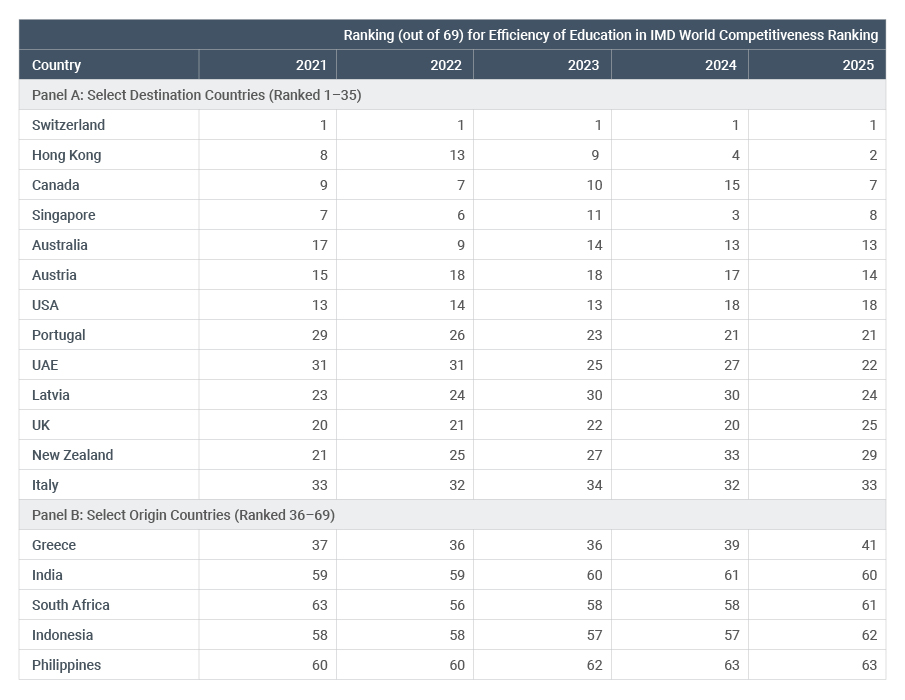
Note: All rankings are out of a maximum of 69 countries.
Source: The IMD World Competitiveness Ranking 2025 accessed 13 March 2026
The Henley Opportunity Index evaluates the broader structural outcomes associated with living, studying, and working in different countries. These outcomes include dimensions such as career advancement, top-tier employment prospects, earning potential, economic mobility, and overall livability. Rather than assessing how education systems perform internally, the index captures the opportunity structure that individuals can access once embedded within those systems. In this sense, the IMD World Competitiveness Ranking’s system-level education efficiency measure complements the Henley Opportunity Index and thus allows us to distinguish between institutional performance and the life-course advantages that such performance helps sustain. Methodological details regarding the construction of the Henley Opportunity Index are provided in the methodology section.

To illustrate the cumulative mechanism, consider a family from Indonesia, which ranks below the top 35 threshold in the education efficiency measure and is therefore classified as an origin environment in this framework. By relocating to an economy ranked within the top tier of the distribution, such as Portugal, their child enters a system with stronger educational outcomes and more effective labor-market integration.
In previous Henley Opportunity Index results, such countries have consistently exhibited stronger outcomes across dimensions including premium education, career advancement, earning potential, and economic mobility. The cumulative advantage arises from enabling unrestricted access to a high-opportunity environment where institutional performance is robust.
Variation across destination countries also matters, as some systems offer deeper integration into global labor markets and therefore more beneficial long-term opportunity paths. This dynamic can also be illustrated from a financial perspective by comparing the investment required to acquire settlement rights through a residence or citizenship program with the potential earnings in destination economies.
The case of a family from an origin country such as Indonesia helps clarify the intergenerational access logic. By obtaining settlement rights in a higher-performing economy through a residence program, the next generation gains access to labor markets with substantially stronger long-term earnings prospects.
For example, securing residence rights in Portugal through Portugal’s Golden Residence Permit Program requires a minimum investment of EUR 250,000 (approximately USD 232,400), which corresponds to a projected 10-year income potential of about USD 513,400 for highly skilled and experienced individuals in leading roles in senior positions.
On the other hand, if the family remains in Indonesia, the 10-year income projection is just USD 73,027.
These figures illustrate the earnings differential between origin and destination economies across a 10-year horizon. The financial contribution required to obtain settlement rights can be understood not simply as a migration cost, but as an investment in intergenerational relocation to institutional systems that offer more resilient opportunity ecosystems. Ultimately, the gap between origin and destination earnings paths is the clearest expression of what institutional access is worth across a generation.
Note: Income projections represent indicative estimates of potential earnings over a 10-year horizon derived from Henley & Partners’ professional salary model and should be interpreted as illustrative rather than predictive. Investment thresholds refer to minimum financial requirements for participation in residence or citizenship programs and may involve structures where part of the investment is recoverable.
The cumulative nature of this mechanism reflects the path-dependent nature of institutional environments. Early access to higher-performing education systems increases the likelihood of entry into stronger labor markets, shaping earnings trajectories, professional networks, and mobility options.
These advantages are self-reinforcing. Initial relocation to institutionally strong systems influences access to further opportunities, including advanced training, leadership pathways, and cross-border career mobility. In this way, settlement rights influence not only immediate educational access, but the long-term path of human capital development, cultivation, and deployment. It is through this compounding logic that a migration decision made by one generation becomes a structural advantage inherited by the next.
The cumulative effect of participating in residence and citizenship programs lies in their ability to enable families to establish themselves within higher-efficiency institutional environments through permanent settlement. In doing so, parents can provide their children with opportunities that would otherwise be constrained by temporary student or postgraduate visa routes. These include access to premium education, richer professional development prospects, and labor markets characterized by stronger earning potential, higher mobility, and more robust institutional conditions.
Over time, this integration enhances the probability of sustained intergenerational advantage by equipping the next generation with skills, credentials, and mobility capacity aligned with higher-performing opportunity structures. Participation in such programs is therefore best understood not as a one-time financial transaction, but as a deliberate intergenerational strategy, one whose returns are measured not in years, but across lifetimes.
Notes
1 The education efficiency ranking corresponds to the education subfactor of the IMD World Competitiveness Ranking. For details on the construction of the education subfactor see the IMD World Competitiveness Ranking 2025 (accessed 13 March 2026).
2 The IMD World Competitiveness Ranking’s education measure includes all countries covered in The Henley Opportunity Index 2026 with the exception of Malta.



As the global leader in residence and citizenship planning, Henley & Partners is best placed to advise you and your family. Contact us for a free consultation.