Callback





Dr. Özgür Öner, M.D. is Professor of Child & Adolescent Psychiatry at Bahçeşehir University Medical School in Istanbul, Türkiye and a research consultant at Boston Children’s Hospital/Harvard Medical School in the USA.
For many globally mobile families, international relocation is closely tied to educational planning. Parents carefully evaluate school systems, curricula, and university pathways before making a move. Yet one important factor is often overlooked in these decisions: psychological readiness for transition.
Families investing considerable sums in investment migration programs, which might result in relocation, routinely conduct extensive legal and financial due diligence. However, psychological readiness — which often determines whether relocation succeeds or fails for children and families — receives far less attention.
Just as academic potential should be professionally assessed before selecting schools, psychological readiness should also be evaluated before committing to relocation. Research consistently shows that 20–30% of family migrations result in significant adjustment challenges within two years, often not because of financial or logistical problems, but because of psychological factors that were present and identifiable beforehand.
Information-based decision-making is essential in relocation planning. The difficulty lies in the complex and evolving nature of psychological wellbeing. Unlike more static financial or legal considerations, psychological readiness involves interactions between child development, family dynamics, support structures, cultural context, and the characteristics of the destination country. Risks across different areas can have cumulative effects that are not always visible when each factor is considered in isolation.
As global mobility increases, more families are making relocation decisions with children’s education as a central consideration. Understanding how children adapt psychologically to new school systems and cultural environments is therefore becoming an increasingly important part of successful international transition planning.
An effective starting point is to develop an evidence-based ‘interactive map’ of a family’s strengths, vulnerabilities, risks, and opportunities, ideally conducted by specialists in child development and cross-cultural transitions.

International relocation readiness cannot be evaluated through simple checklists or single-factor analysis. A structured assessment typically examines five key domains while also considering how they interact.
Five domains for assessing relocation readiness
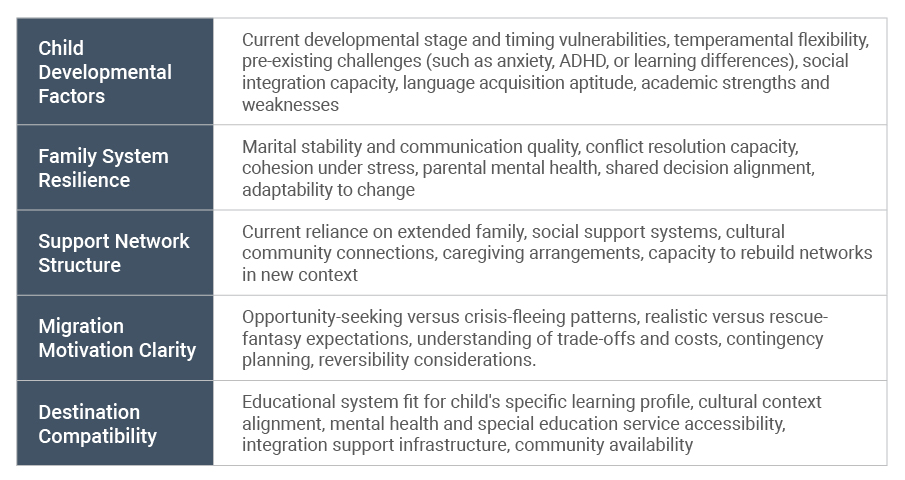
As the case example below illustrates, these factors rarely operate independently. Effective assessment therefore examines how these domains combine to shape a family’s unique adjustment profile.
After relocating to the UK, a family sought consultation due to their seven-year-old daughter’s severe adjustment problems. The child’s youth had initially appeared advantageous owing to the linguistic flexibility, social adaptability, and limited established peer attachments that are associated with this age.
Before relocation, she had mild reading difficulties and minor behavioral challenges. In her home country, these were effectively managed through additional support from her teacher, significant involvement from her grandparents, and full-time assistance from her child’s caregiver — all common and accessible in the local context.
After the family migrated, this support network disappeared. What had appeared to be mild learning difficulties in her home language emerged as a more serious learning challenge in English. Furthermore, her behavioral issues intensified without her familiar caregivers and routines.
The child’s difficulties were most evident in the school environment, where language barriers and the absence of tailored learning support quickly affected her academic confidence and classroom participation. Meanwhile, the parents struggled to access timely mental health services within the UK system, leading to eight-month delays in diagnosis and intervention.
The result was significant financial cost in private assessments and therapy, along with 18 months of family stress and serious consideration of returning home.
An earlier pre-relocation assessment could have identified this vulnerability–support mismatch and enabled the family to prepare more effectively.
The case example illustrates why general advice such as “young children adapt more easily” can be misleading. Research confirms that immigrant children’s adjustment outcomes depend on interactions between individual characteristics, cultural context, and the receiving environment.
Professional evaluation can help families identify areas of strength and potential vulnerability, enabling them to prepare more strategically before they relocate. The interactive factors are assessed to categorize overall risk — low, moderate, or high — and identify intervention points, revealing which vulnerabilities require remediation, which strengths can be leveraged, and whether the timing of the relocation should be reconsidered.
For low-risk families — those who are strong across all five domains — assessment primarily confirms the decision to relocate, highlights two or three minor preparation priorities, and provides a baseline for monitoring post-migration adjustment.
For moderate-risk families — those who display vulnerabilities in one or two domains — targeted preparation may be recommended — for example, addressing undiagnosed learning differences, strengthening family communication, or relationship counseling.
For high-risk families — those with multiple vulnerabilities in three or more domains or severe challenges in critical areas — recommendations may include significantly delaying or even reconsidering migration or implementing more intensive preparation strategies before proceeding.
Assessment can also help families establish realistic benchmarks for monitoring adjustment after relocation. These may include expected timelines for forming peer friendships, acceptable academic performance ranges during language transitions, indicators that distinguish normal adjustment stress from emerging problems, and predetermined decision points for seeking intervention versus allowing natural adaptation.
In this way, relocation becomes a strategically planned transition rather than an unmanaged risk.
Many families face compressed decision timelines when relocating — whether due to unexpected political developments, economic uncertainty, sudden career opportunities, or tax considerations. Time pressure does not eliminate the importance of psychological preparation; in fact, it often increases it.
Focused assessment, which can be conducted in a few hours via a virtual consultation, with a report and recommendations within a week, can provide valuable guidance even when timelines are tight.
A family facing urgent economic pressures in their home country needed to relocate within three months, leaving little time for traditional preparation.
Assessment revealed moderate overall risk: two children aged six and eight with good developmental timing and strong family cohesion, but the parents were experiencing significant anxiety about the unknown and had limited previous international experience.
The need for a critical intervention was identified, with three accelerated family sessions focusing
on setting realistic expectations, managing anxiety, and practical adaptation strategies. The family established clear benchmarks for the transition — including social integration milestones (a first friend by month three) and participation in activities (participating by month two) — and predetermined points at which they would seek professional support if needed (if both children showed persistent distress at six months, the family would seek professional support immediately).
Follow-up monitoring at three, six, and twelve months confirmed they had adapted successfully. Early guidance had helped prevent minor adjustment stress from escalating.
Even under time pressure, assessment and structured preparation can transform uncertain relocation into a managed transition with clear priorities, realistic expectations, and predetermined support triggers.
International relocation can offer exceptional educational opportunities, but successful transitions depend not only on choosing the right school system but also on ensuring that children are psychologically prepared for change.
Families planning international moves typically invest significant effort in legal and financial planning. Psychological readiness deserves similar attention. Professional evaluation can help parents understand how developmental, family, and environmental factors interact, identify potential adjustment challenges, and guide preparation before relocation, enabling them to make informed decisions about whether to proceed, optimal timing, destination selection, essential preparation, and post-migration adjustment tracking.
Seeking consultation early in the decision-making process provides the greatest flexibility. Working with specialists familiar with relocation psychology and cross-cultural transitions can help families anticipate challenges and support children through school and social transitions in a new country.



As the global leader in residence and citizenship planning, Henley & Partners is best placed to advise you and your family. Contact us for a free consultation.