Callback




For globally mobile families, choosing a curriculum is an important decision, both academically and strategically. Although the International Baccalaureate (IB), the British curriculum, and Advanced Placement (AP) are recognized around the world, different systems are aligned with different higher education routes and labor markets, meaning the choice of curriculum can directly influence future outcomes. At Henley & Partners Education, this decision sits at the heart of our advisory work, where we combine data-driven academic profiling with residence and citizenship planning to help families align education choices with long-term global opportunity.
This explainer compares the IB, the British curriculum, and AP, helping families make informed decisions about the pathways that best support their child’s future.
Developed by the International Baccalaureate Organization, the IB is offered in over 150 countries and is known for academic rigor and global recognition.
The IB offers four programs: the Primary Years Programme for ages 3–12, the Middle Years Programme for ages 11–16, the Diploma Programme (DP) for ages 16–19, and the Career-related Programme, also for ages 16–19.
The most well-known is the DP, which students take in the final two years of school.

The DP aims to develop well-rounded students who flourish on all levels: physically, intellectually, emotionally, and ethically.
The curriculum consists of six subject groups across disciplines as well as the DP core, which comprises the extended essay (an independent research project), theory of Knowledge (TOK — a critical thinking course), and creativity, activity, service (CAS).
The six subject groups are studies in language and literature, language acquisition, individuals and societies, sciences, mathematics, and arts. A minimum of three and a maximum of four subjects are taken at higher level and the rest are taken at standard level.
The DP is highly global in scope and widely transferable, making it an attractive option for families who relocate or who are planning for university study abroad.
The program is especially strong in preparing students for university-level research and academic writing, equipping them with the skills needed to succeed in demanding higher education environments.
A key strength lies in its emphasis on critical thinking, inquiry-based learning, and global awareness, encouraging students to engage deeply with complex issues and diverse perspectives. In addition, the balanced curriculum ensures that students maintain exposure across a broad range of disciplines, fostering well-rounded intellectual development.
However, the DP is also known for its intensity. The workload can be heavy, requiring strong time-management skills and sustained commitment. Its structured nature means there is less flexibility compared to some other systems, as students are required to study subjects across multiple disciplines rather than specializing early. Furthermore, final grades are determined in part by a combination of external examinations and internally assessed coursework, which can add pressure and limit opportunities to compensate for weaker exam performance.
The DP is particularly well suited to families who move between countries frequently, those who value a broad and balanced academic foundation, and those who prioritize a holistic approach to education that develops both intellectual and personal capabilities.
Often referred to as the English National Curriculum, this system is widely used in the UK and has been adopted by many international schools around the world. Its global presence, combined with strong academic standards, makes it a popular choice for families seeking a structured and well-established pathway through secondary education.
The curriculum is divided into two main stages. Students first complete the General Certificate of Secondary Education (GCSE or IGCSE) between the ages of 14 and 16, followed by A-Levels between the ages of 16 and 18.
GCSEs are offered by leading examination boards such as Cambridge Assessment International Education and Pearson Edexcel, and provide a broad foundation across a range of subjects. At A-Level, students narrow their focus significantly, usually selecting three to four subjects to study in depth over a two-year period.
A defining feature of the British system is this early move toward specialization. Compared to the IB, students begin concentrating on their strongest subjects at an earlier stage, allowing for a more focused and academically intensive study experience.
A-Levels, in particular, are known for their depth and rigor within individual disciplines, making them highly regarded by universities, especially in the UK and other Commonwealth countries. Assessment is largely examination-based, with final grades determined primarily through end-of-course exams, although some subjects may include coursework components.
The opportunity for deep subject specialization makes the British curriculum particularly suitable for students with clear academic interests or career ambitions, such as medicine, engineering, or law. It allows learners to focus on their strengths and develop a high level of expertise in chosen fields. The qualification is also widely respected by universities globally, providing a clear and direct route into higher education.
At the same time, the narrower academic breadth at A-Level means that students may have less exposure to a wide range of disciplines compared to more holistic programs such as the IB. The strong emphasis on final examinations can also create pressure, as performance on a limited number of assessments has a significant impact on overall results. In addition, there is generally less emphasis on interdisciplinary learning, research projects, and the development of broader competencies such as critical inquiry across subject boundaries.
The British curriculum is well suited to families who have a clear sense of their child’s academic strengths and future direction, especially those targeting admission to UK universities or pursuing specialized career paths. It offers a focused, academically rigorous education that rewards depth of knowledge and subject mastery.
AP courses are developed by the College Board, the same body responsible for administering the SAT, and form part of the broader American high school diploma system. Unlike the IB DP or A-Levels, AP is not a standalone curriculum but rather a suite of advanced, university-level courses that students can choose to take alongside their standard high school studies. This flexible structure has contributed to its widespread adoption in both the USA and international schools offering an American-style education.
Students follow a general high school curriculum with the option to select individual AP subjects based on their interests and academic strengths. These can range across disciplines, including subjects such as AP Calculus, AP Biology, AP Economics, and AP English Literature. Each course culminates in a standardized examination, with scores ranging from 1 to 5. High scores — typically 4 or 5 — may be used to earn university credit or advanced placement at many institutions, particularly in the USA.
A defining characteristic of the AP system is its flexibility. Students can decide how many AP courses to take, allowing them to tailor their academic experience according to their capacity, interests, and future goals. This makes it possible to pursue subject specialization without committing to a comprehensive program like the IB DP. It also enables students to balance academic rigor with other priorities, such as extracurricular activities, which can be an important consideration for overall development and university applications.
The advantages are clear. The high degree of customization allows students to build a personalized academic profile, focusing on their strengths while maintaining a manageable workload. AP courses are widely recognized by US universities and are considered strong preparation for the expectations of higher education in that system. At the same time, students benefit from exposure to college-level material while still in a high school environment.
However, as AP is not a standardized, full-program framework, the quality and rigor of courses can vary between schools. Unlike the IB DP, there are typically no compulsory core components such as extended research essays or interdisciplinary courses, unless these are introduced by individual schools. In addition, while AP is generally well known internationally, recognition and the extent of university credit awarded can vary outside the USA.
Overall, the AP system is particularly well suited to families who value flexibility in subject choice and academic pacing, as well as those planning for university study in the USA. It offers a customizable and academically challenging pathway that allows students to shape their education around their individual strengths and ambitions.
The table below provides a high-level overview of the three curricula for comparative purposes.
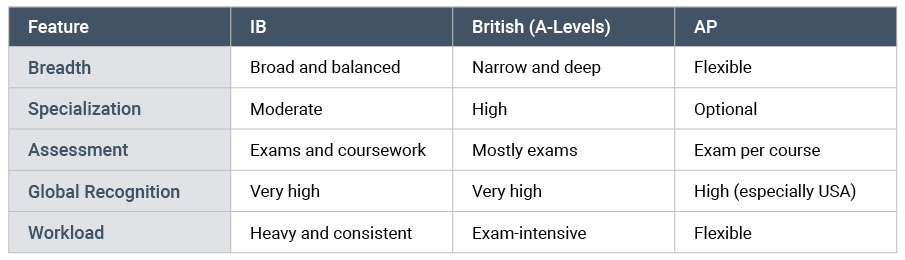
There is no universally ‘best’ curriculum — only the best fit for your child: a curriculum that aligns with their needs, strengths, and future aspirations.
Choosing the right pathway requires careful consideration of several key factors. These include your child’s intended university destination, whether in the UK, the USA, Europe, Australasia, or Asia, as different systems are often better aligned with specific higher education routes.
Equally important is their learning style, whether they thrive in a highly structured environment or prefer greater flexibility and choice in their studies.
Academic strengths also play a crucial role. Some students benefit from a broad, balanced curriculum, while others excel when given the opportunity to specialize in a smaller number of subjects.
Finally, family mobility should be taken into account. For families who relocate frequently, a globally transferable and widely recognized curriculum may offer greater continuity and ease of transition.



As the global leader in residence and citizenship planning, Henley & Partners is best placed to advise you and your family. Contact us for a free consultation.