Callback




Dr. José Caballero is a Senior Economist at the IMD World Competitiveness Center in Lausanne, Switzerland.
The IMD World Competitiveness Ranking, produced by the IMD World Competitiveness Center, measures how well countries manage their overall resources to enhance their creation of long-term value. The ranking covers 69 countries and considers more than 250 criteria, of which two thirds are statistical and one third is survey data from the responses of about 6,100 international executives.
This article traces the impact of two drivers of competitiveness: country image, and the quality of life a nation offers. In addition, it delineates the relationship between competitiveness, talent development or acquisition, and the existence of residence programs.
The competitiveness ranking includes a criterion related to the reputation of countries. This criterion evaluates how a country is viewed abroad by asking executives to evaluate if the government of the country in which they reside encourages business development. The evaluation of a country’s image may reflect the impact of factors such as perceptions of business regulation, the country’s adherence to the rules of international trade, and the existence of barriers to investment by foreign nationals (such as the regulation of capital markets).

The ranking also measures quality of life by encouraging executives to reflect on whether they consider their country’s quality of life to be high or low. Factors that may influence this criterion include the individual’s ability to meet their ‘material’ expectations (for example, access to specific goods and services), their life satisfaction (for example, ability to enjoy family time), and absence of threats (for example, effective government policies against crime and for the protection of individual rights). Furthermore, quality of life is a decisive factor for individuals considering relocating to a particular destination country.
The IMD World Competitiveness Center also publishes the yearly IMD World Talent Ranking. Talent is the set of skills and competencies necessary to successfully perform specific activities. The talent ranking assesses the extent to which countries develop, attract, and retain talent in order to sustain the talent pool available for enterprises operating in their economies.
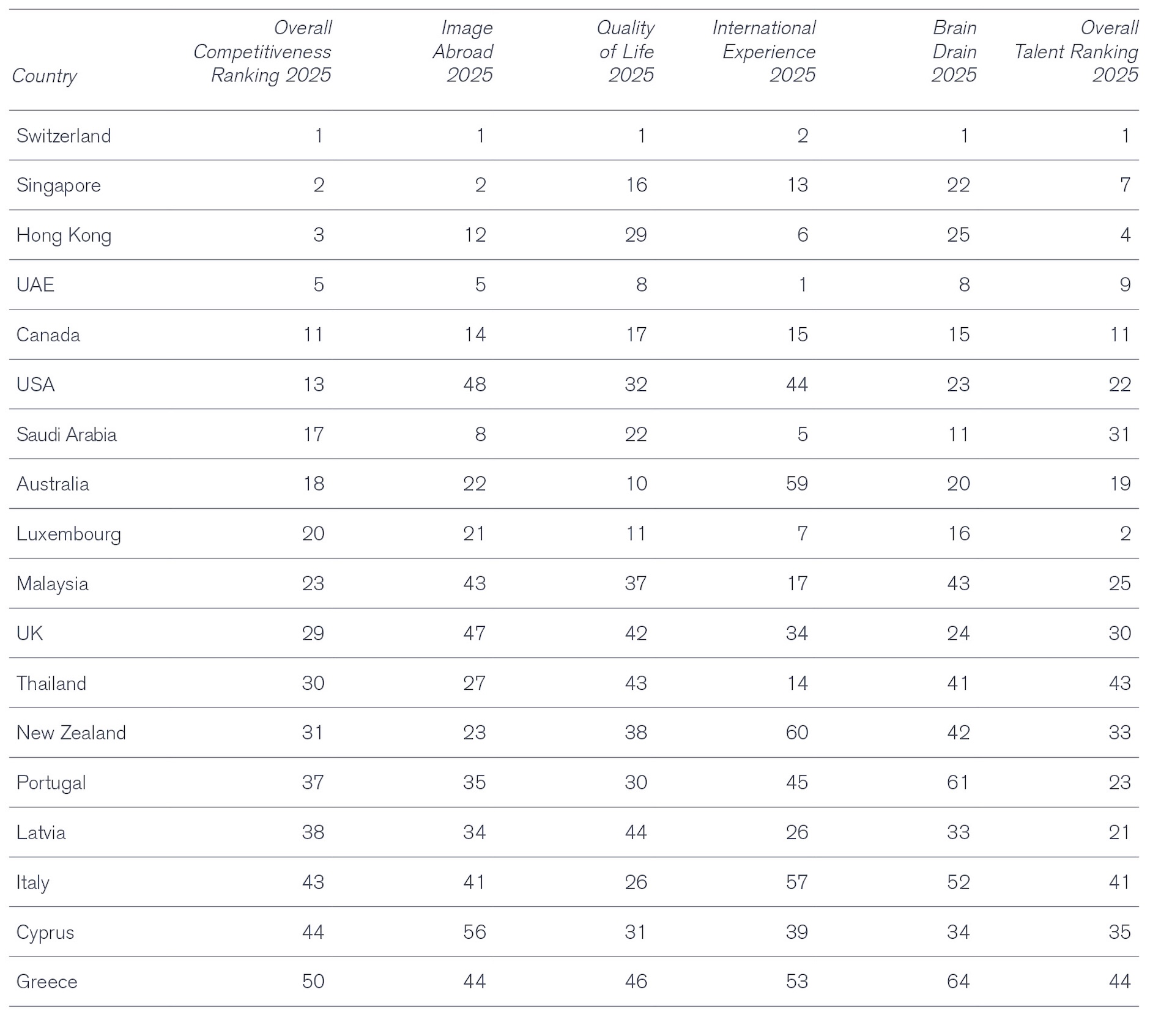
Table 1 shows the overall 2025 IMD World Competitiveness Ranking, the two survey rankings based on the image abroad and quality-of-life criteria, another survey-based ranking assessing the availability of senior managers with international experience, and the overall 2025 IMD World Talent Ranking. Please note that Table 1 includes only countries that are common to the IMD World Competitiveness and IMD World Talent rankings and Henley and Partners’ 2026 Global Residence Program Index featured in this publication (though not discussed in this article).
Overall, there is a strong correlation between a country’s competitiveness ranking and its international image as a place to do business. The sample presented includes 13 of the top half of the countries from the overall competitiveness ranking. Of those 13, 12 also make it into the top half for having an image abroad that encourages business development, according to executives in each of these countries.
Table 1. Competitiveness and relevant criteria
Sources: IMD World Competitiveness Ranking (2025) and IMD World Talent Ranking (2025)
Some executives, however, are far gloomier about their countries’ images, which leads to some incongruities between the competitiveness ranking and a country’s image. For example, the USA ranks 13th in overall competitiveness but reaches the 48th position for image abroad. Similarly, the UK ranks 29th and 47th, respectively. In the case of the USA, reputational volatility stems from deepening political polarization, which continues to affect perceptions of institutional predictability. Partisan gridlock in Congress, recurrent disputes over electoral processes, and sharply divided public opinion on issues such as climate policy and foreign commitments all contribute to an image of fragility in governance. In the UK, debates around migration and national identity remain contentious, particularly in the aftermath of Brexit. Shifts in immigration rules, ongoing discussions about the balance between openness and sovereignty, and domestic political divisions over multi-culturalism influence how the country is perceived abroad.
In relation to quality of life, it seems that some executives residing in countries in the top 10 of the competitiveness ranking find the quality of life in those countries in need of enrichment. For example, Hong Kong ranks 3rd in competitiveness but reaches only the 29th place by the quality-of-life criterion. Of the sample presented, only Switzerland and the UAE are among the top 10 countries in both rankings. It is noteworthy, also, that Australia, Canada, Luxembourg, and Singapore appear within the quality of life top 20 while also ranking in the top 20 for competitiveness.
Executives from countries in the lower competitiveness rankings perceive the quality of life in those countries to be high. For example, Cyprus ranks 44th in competitiveness but 31st in quality of life; similarly, Italy ranks 43rd in competitiveness but 26th in quality of life. This trend is consistent with studies that note an inverse relationship between economic progress and elements of the quality of life.
It is important to note that survey data from the 2025 IMD Executive Survey indicates a significant shift in relocation priorities among internationally mobile executives. While quality of life remains fundamental, financial incentives have re-emerged as one of the primary drivers of executive relocation decisions. Approximately 62.5% of executives cited financial concerns such as cost-of-living and tax incentives as a dominant factor influencing their mobility. This marks a shift from earlier findings in which lifestyle and cultural alignment outweighed economic considerations.
The IMD World Competitiveness Ranking and the Global Residence Program Index largely coincide, although there are exceptions. In competitiveness, while Hong Kong, Malaysia, and New Zealand rank in the top half of the group (3rd, 23rd, and 31st, respectively), they are in the bottom half of the Global Residence Program Index (14th, 12th, and 8th, respectively).
The parallels between the overall IMD World Talent Ranking and the Global Residence Program Index are also interesting. Australia, Canada, Luxembourg, Portugal, Singapore, Switzerland, the UAE, and the UK rank in the top half of both. However, Hong Kong, Latvia, and the USA rank in the top half in talent (4th, 21st, and 22nd, respectively) but remain in the bottom half of the Global Residence Program Index.
A lack of alignment does not lessen the importance of the dynamics: relevant research continually highlights the positive impact of the internationalization of domestic workforces through exposure to global knowledge, broader experience, and understanding of a wider set of best practices provided by the inflow of foreign personnel. Evidence suggests that there are links between such exposure and the drivers of business leadership capabilities and competencies. Residence and citizenship programs thus contribute to the development of local talent by improving the quality of business leadership available. Such programs also contribute to the mitigation of the impact of brain drain on the competitiveness of the destination countries. Table 1 shows that most countries in the top half of the ranking that assesses the availability of senior managers with significant international experience (the international experience column in Table 1) and in the ranking that captures the impact of brain drain on the economy (the brain drain column in Table 1) also rank in the top half of the overall talent ranking and the top half of the Global Residence Program Index.
In the current climate of volatility, characterized by inflationary pressures, geopolitical uncertainty, and unstable markets, residence programs that offer tax incentives or financial stability have become particularly attractive to executives. Such programs are increasingly viewed not only as gateways to particular lifestyles and business opportunities but also as financial risk-mitigation tools in a “permacrisis” era. At the same time, the relocation decisions of executives are more than individual economic transactions. They function as visible signals of a country’s overall attractiveness, indicating the presence of an environment that is conducive to investment, business continuity, and long-term wealth planning. In this, countries that effectively blend financial competitiveness with quality infrastructure (including education, health, and transport), while also offering fine-tuned residence pathways, are best positioned to attract globally mobile executives. The success of Switzerland, Singapore, and the UAE in terms of overall competitiveness, talent, and international image supports such an integrative logic. Executive mobility also plays a broader systemic role. Although executives are not always direct participants in residence or citizenship programs, their presence enhances competitiveness by strengthening business ecosystems, signaling confidence to international investors, and reinforcing the value proposition for family offices and high-net-worth individuals. In the current highly unpredictable international system, however, financial predictability remains the foundation upon which other relocation factors are evaluated.
Dr. José Caballero is a senior economist at the IMD World Competitiveness Center in Lausanne, Switzerland, where he leads research on models to assess the competitiveness of countries and firms. His work focuses on identifying the structural and dynamic drivers of competitiveness and translating them into comparative measurement tools. His research interests include competitiveness, institutional governance, and the social asymmetries that affect long-term value creation, with the aim of designing mechanisms that mitigate these asymmetries and strengthen sustainable competitive capacity. His analyses are widely disseminated through academic publications, specialized reports, and international media platforms.
Dr. Caballero has collaborated with the World Justice Project on the Rule of Law Index® and undertaken research or consultancy roles with institutions such as Yale University, the National Bureau of Economic Research, the World Bank, and the Inter-American Development Bank. He is a specialist in comparative political economy, with a focus on institutional processes and structural dynamics, and has taught at the University of Warwick and the University of the West of England.
He holds a PhD (Politics and International Studies) from the University of Warwick and an MA (Social Science: Government) from Harvard University. His professional experience spans Latin America, Europe, Asia, and the Middle East, with a focus on competitiveness, governance, and institutional development across diverse economic and institutional contexts.



As the global leader in residence and citizenship planning, Henley & Partners is best placed to advise you and your family. Contact us for a free consultation.