Callback





Jean Paul Fabri is Chief Economist at Henley & Partners.
The story of Tuvalu’s first climate-linked visas to Australia is more than a human-interest headline. It is a constitutional moment for the international system. A low-lying atoll state, home to just over 11,000 people, Tuvalu is now planning for a future in which much of its territory may become uninhabitable.
By climate citizenship, we mean a new model of belonging and protection in a warming world: one that treats the right to a safe climate, dignified mobility, and cultural continuity as core elements of citizenship, rather than as afterthoughts to territory and passports. Climate citizenship recognizes that where people can live, work, and raise families is now directly shaped by global emissions, not just by national borders.
This shift is already visible in the Australia–Tuvalu Falepili Union. Signed in 2023, the treaty creates the world’s first dedicated climate mobility pathway. Up to 280 Tuvaluans a year — roughly 2.5% of the population — can obtain a new ‘Falepili Mobility Pathway’ visa that allows them to live, work, and study in Australia, with a route to permanent residence.
The visa is open to all Tuvaluan citizens, with no upper age limit and no requirement for a job offer. Children can apply as dependants; adults, including those with disabilities or chronic health conditions, can apply independently. Visa holders have “freedom for unlimited travel” between Tuvalu and Australia and immediate access to subsidized education, Medicare, the National Disability Insurance Scheme, and key family benefits. This ensures that relocating does not mean starting from zero but stepping into a system that supports stability and integration.
The Falepili visa is more than a migration mechanism; it is a model for climate-adaptation mobility that preserves identity, continuity, and dignity even as environmental pressures intensify. Demand has been overwhelming. Within weeks of the first ballot opening in June 2025, more than a third of Tuvalu’s residents registered for a chance to relocate. For many families this is not only about escape; it is an adaptation strategy that combines remittances, education, and long-term security.
At present, this pathway is treaty-based and specific to Tuvalu — it is not a general visa for “sinking nations” or for other climate disasters. However, it creates a template that could, in principle, be replicated for other atoll states or climate frontlines.
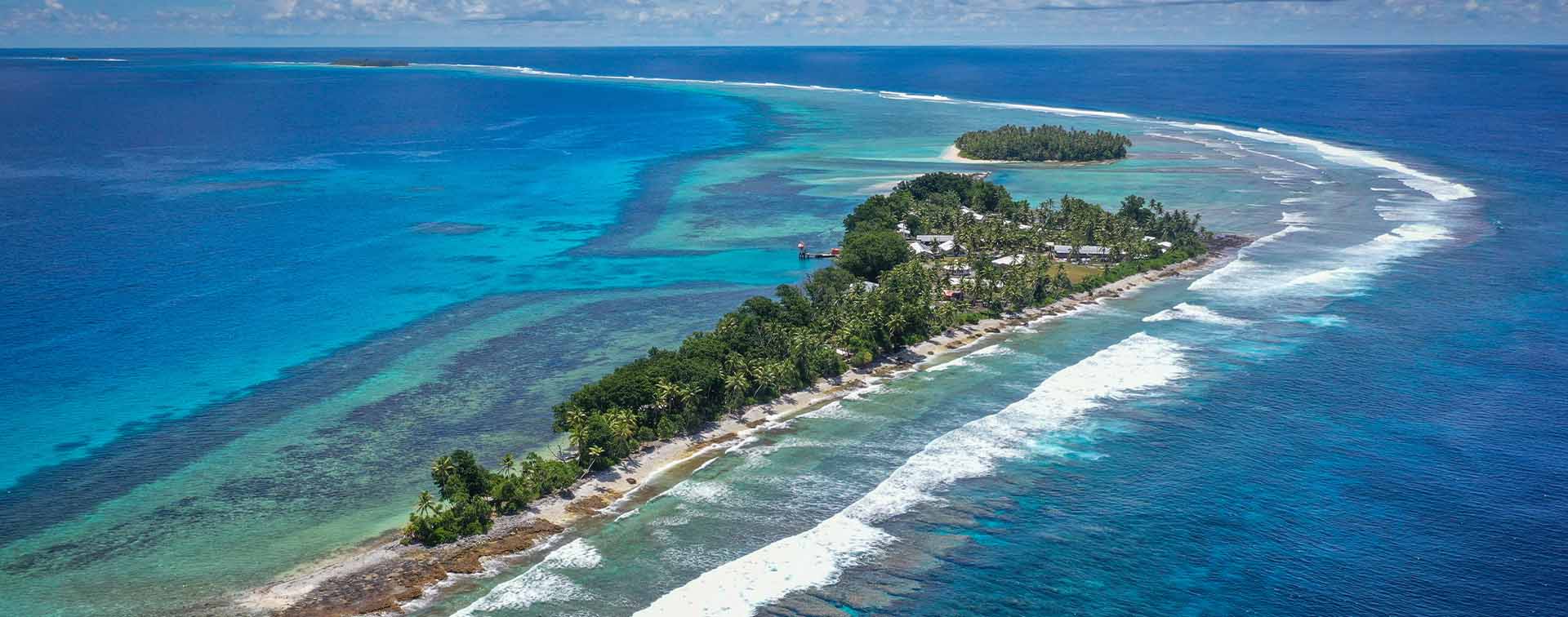
Tuvalu’s deal is notable for another reason. It explicitly decouples the idea of a state from the permanence of its land. Even if Tuvalu were to lose large parts of its territory, the treaty recognizes its ongoing sovereignty, UN membership, and extensive exclusive economic zone.
This is climate citizenship in action: sovereignty and identity anchored in people, institutions, and rights, not just in soil. Citizenship becomes portable; a bundle of protections that can travel with communities, rather than dissolve when coastlines retreat.
Yet the scale of the challenge goes far beyond one Pacific nation. Research highlights several other low-lying atoll states at extreme risk of partial or total uninhabitability this century, including Kiribati, the Maldives, the Marshall Islands, and Nauru, alongside Tokelau and Tuvalu. Together, these countries account for several hundred thousand citizens whose homelands are already experiencing flooding, salinized freshwater, and coastal erosion.
Broader UN groupings identify 43 small island and low-lying coastal states as particularly susceptible to sea-level rise, storms, and ocean warming. Legal scholars now speak of a “spectre of climate statelessness” as entire territories risk becoming uninhabitable or even disappearing, while international law remains poorly equipped to guarantee nationality, voting rights and cultural continuity in such scenarios.
Overlay this with global projections that, by 2070, up to 3 billion people may live outside today’s habitable climate niche, and the urgency becomes clear: Tuvalu is a harbinger, not an outlier.
Climate citizenship does not sit in a vacuum. It must be matched by new forms of climate finance that allow vulnerable states to remain viable, economically and politically, even as mobility increases.
The Henley & Partners Citizenship by Investment: Sustainable Climate Finance for Governments report published in partnership with the Climate Vulnerable Forum argues that hosting citizenship programs can evolve into “sovereign equity”: a way for climate-threatened states to convert carefully managed citizenship rights into non-debt capital for resilience, infrastructure, and diversification. Nauru’s Economic and Climate Resilience Citizenship Program and similar models in the Caribbean demonstrate how citizenship by investment revenues can be channeled into resilience funds, blue-economy projects, and debt-for-nature swaps, turning vulnerability into long-term assets.
Tuvalu’s Falepili visa operates at the level of individual mobility. Sovereign equity programs operate at the level of national balance sheets. Climate citizenship brings these together: a framework where people can move with dignity, cultures and sovereignties are preserved, and states have the resources to invest in adaptation rather than be trapped in debt.
For now, Tuvalu’s climate visa is a world-first. But it points toward the norms that a climate-shocked century will require:
Climate citizenship is, in essence, a new social contract: between high- and low-emitting nations, between mobile investors and climate-vulnerable communities, and between present and future generations. If scaled thoughtfully, it can turn what looks like an inevitable story of loss into one of continuity, agency, and shared stewardship of a warming planet.



As the global leader in residence and citizenship planning, Henley & Partners is best placed to advise you and your family. Contact us for a free consultation.