Callback





For two decades, the Henley Passport Index has been the world's original and most authoritative passport index, setting the global standard for measuring passport strength and freedom of movement. Based on exclusive International Air Transport Association (IATA) data and enhanced by Henley & Partners' expert research, it tracks 199 passports and 227 travel destinations, providing the definitive record of how global mobility has evolved over the past 20 years.
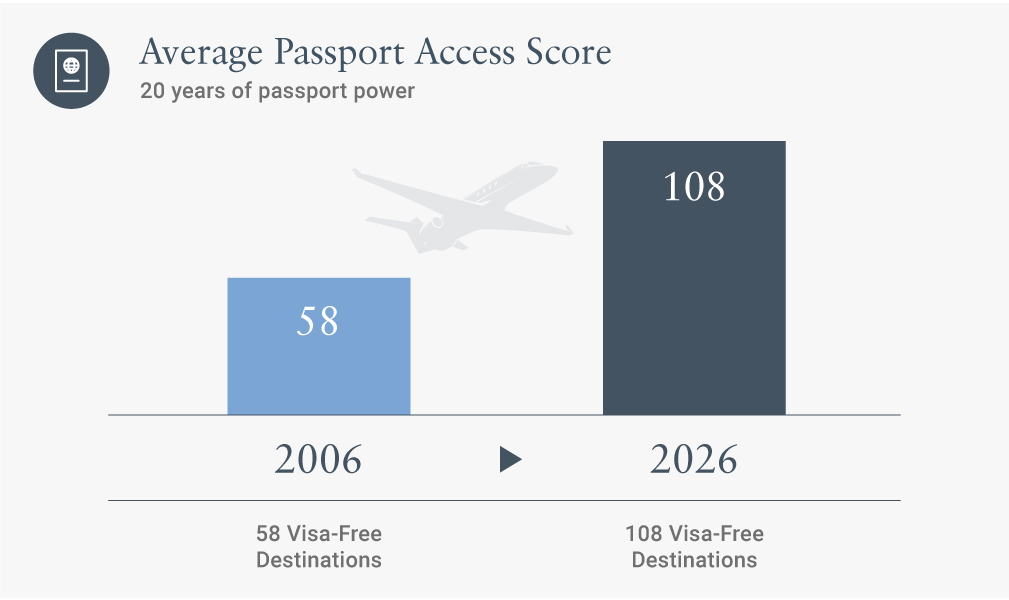
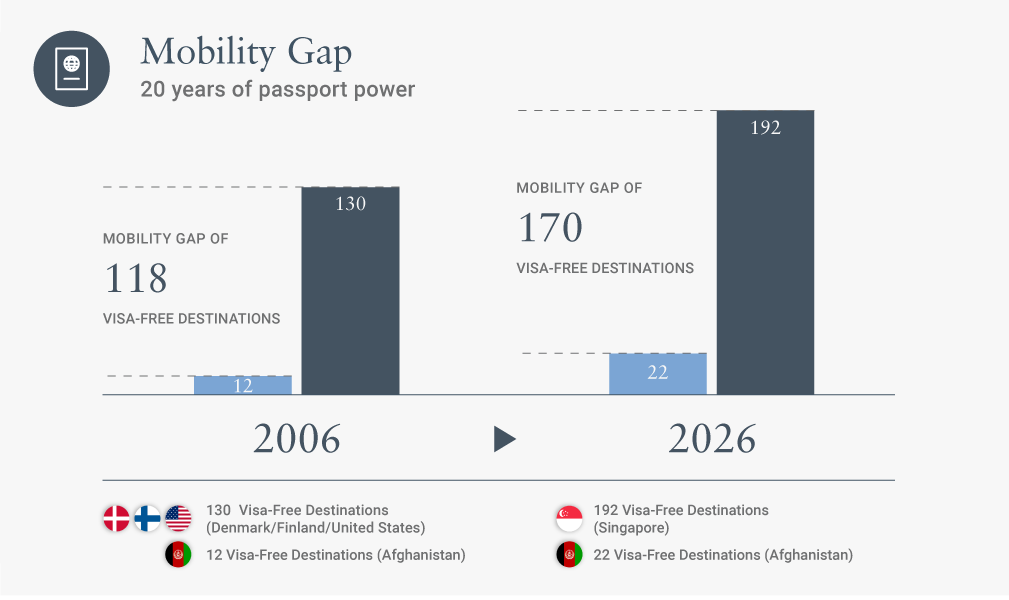
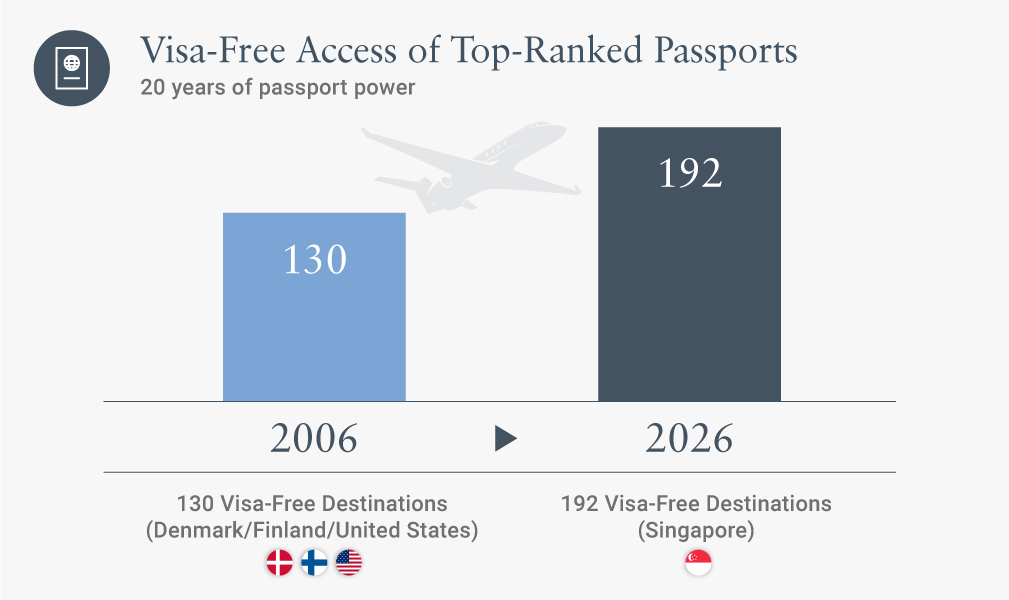
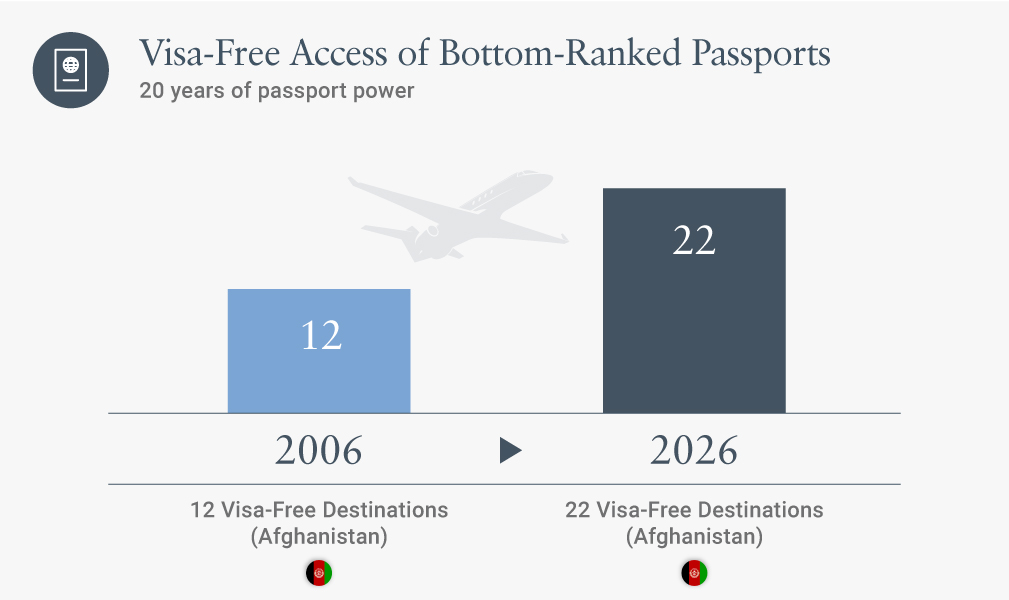
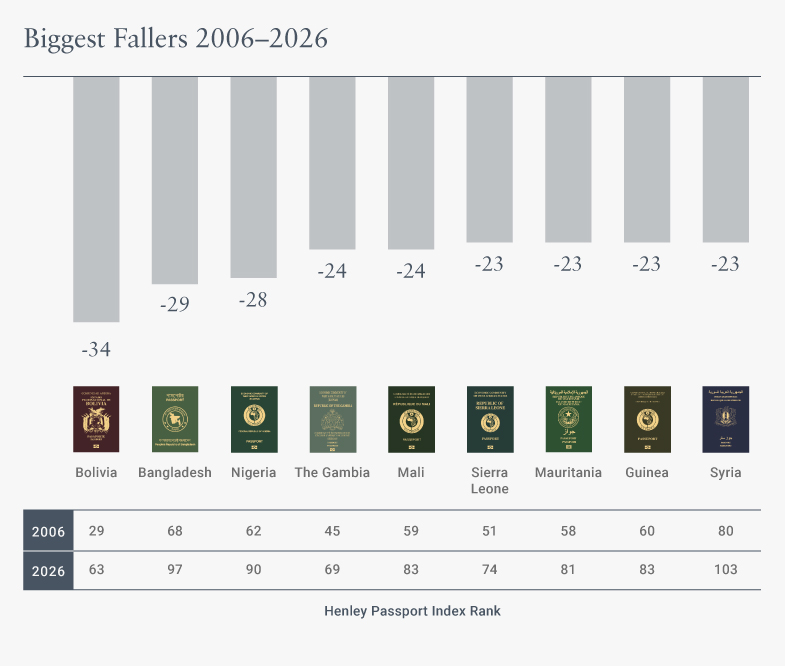
Passport power is not static. Comparing Henley Passport Index rankings between 2006 and 2026 reveals the countries that have made the greatest gains in global mobility, as well as those that have experienced the steepest declines. The results show how sustained diplomatic engagement can expand travel freedom, while conflict, isolation, and shifting geopolitical relationships can erode it.
Download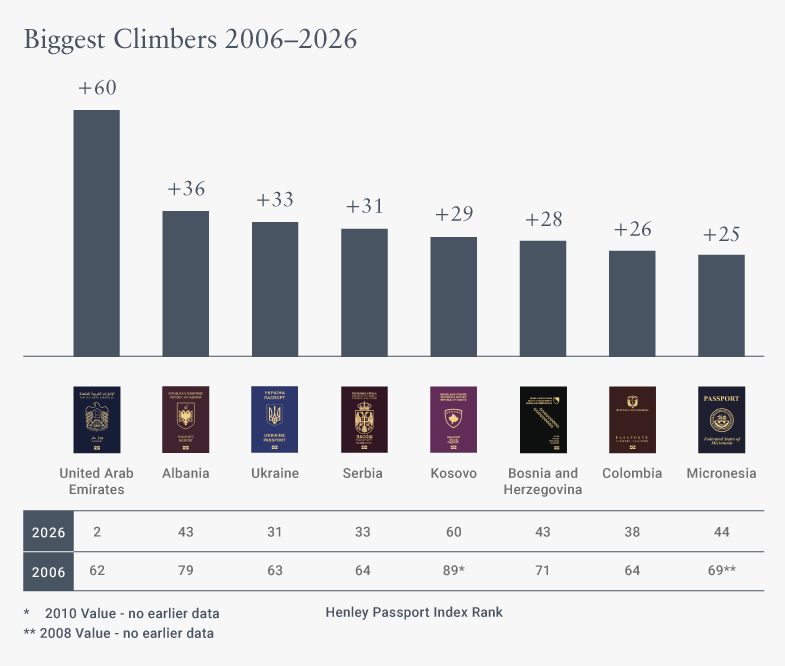
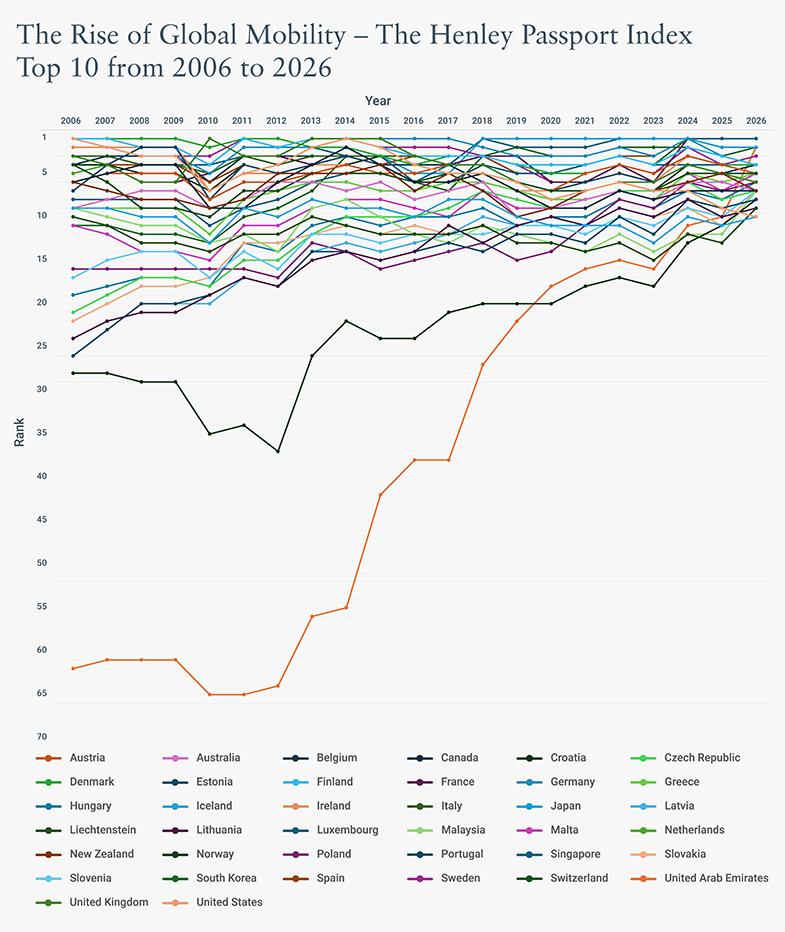
The world's most powerful passports have grown stronger together. In 2006, just 26 passports occupied the top 10 places on the Henley Passport Index. Today, 38 passports share those rankings, reflecting both the expansion of visa-free travel and the growing convergence among the world's most internationally connected nations.
Download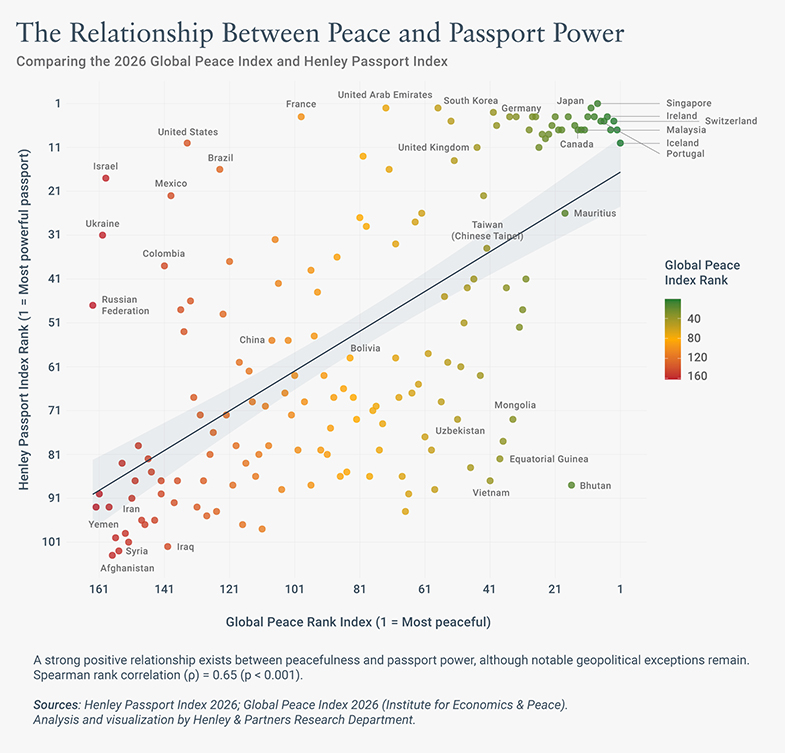
A comparison of the 2026 Henley Passport Index and the 2026 Global Peace Index reveals a strong positive relationship between peacefulness and passport power. Each point represents a country's current ranking in both indexes, showing that while the world's most peaceful nations generally enjoy the strongest passports, and vice versa, notable outliers demonstrate that diplomacy, international trust, and geopolitical influence can strengthen — or weaken — mobility beyond what peace alone would predict.
DownloadWhile peaceful countries generally enjoy stronger passports, some nations consistently outperform — or underperform — what their level of peacefulness would suggest. By comparing each country's Henley Passport Index ranking with its Global Peace Index ranking, this analysis identifies the countries that depart most significantly from the global relationship between peace and passport power, revealing the influence of diplomacy, international partnerships, and geopolitical strategy.
Country | Global Peace Index Rank (2026) | Henley Passport Index Rank (2026) | Difference from Expected Passport Strength |
|---|---|---|---|
Israel | 159 | 18 | 70 places stronger |
United States | 134 | 10 | 67 places stronger |
Ukraine | 160 | 31 | 58 places stronger |
France | 99 | 4 | 57 places stronger |
Mexico | 139 | 22 | 57 places stronger |
Brazil | 124 | 16 | 56 places stronger |
United Arab Emirates | 73 | 2 | 47 places stronger |
Russian Federation | 163 | 47 | 43 places stronger |
Colombia | 141 | 38 | 42 places stronger |
South Korea | 57 | 2 | 40 places stronger |
Country | Global Peace Index Rank (2026) | Henley Passport Index Rank (2026) | Difference from Expected Passport Strength |
|---|---|---|---|
Bhutan | 16 | 88 | 65 places weaker |
Vietnam | 41 | 87 | 52 places weaker |
Equatorial Guinea | 38 | 82 | 49 places weaker |
Tajikistan | 47 | 84 | 47 places weaker |
Laos | 58 | 89 | 47 places weaker |
Sri Lanka | 67 | 94 | 47 places weaker |
Uzbekistan | 37 | 78 | 45 places weaker |
Turkmenistan | 66 | 90 | 44 places weaker |
Mongolia | 34 | 73 | 41 places weaker |
Note: The final column shows how much stronger or weaker each country's passport is than would be expected based on the overall relationship between peacefulness and passport power. Larger differences indicate countries that depart most significantly from the global trend.
Methodology: A linear regression model was used to estimate each country's expected Henley Passport Index ranking based on its Global Peace Index ranking. The difference between the expected and actual passport ranking (the residual) measures how far each country departs from the global relationship between peace and passport power. Only countries whose rankings differ by 40 places or more from the model's prediction are included.
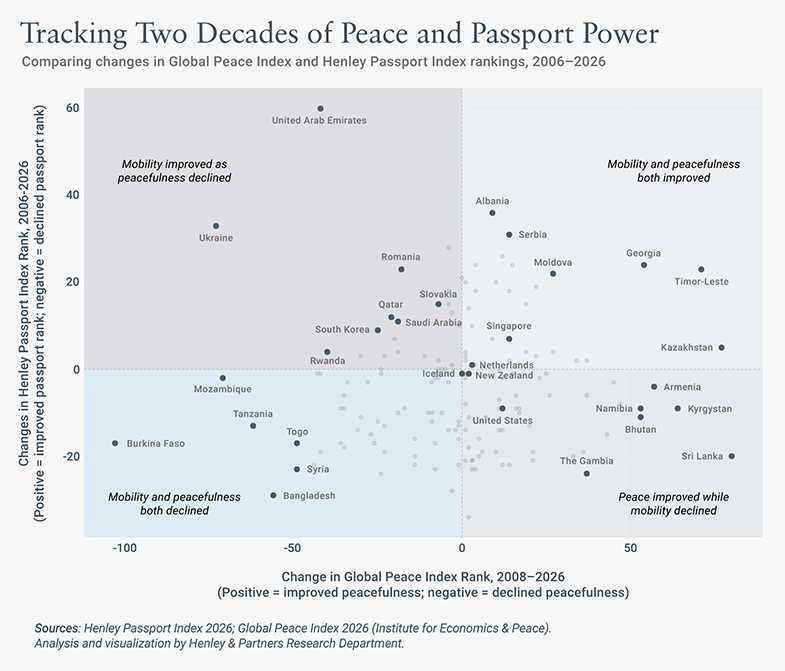
This analysis compares how countries have changed over time rather than where they rank today. Each country is plotted according to the change in its Henley Passport Index ranking (2006–2026) and its Global Peace Index ranking (2008–2026), revealing four distinct national trajectories. While many countries experienced parallel changes in mobility and peacefulness, others broke the pattern, demonstrating that passport power is increasingly shaped by diplomacy, international partnerships, and geopolitical strategy as well as peace.
Download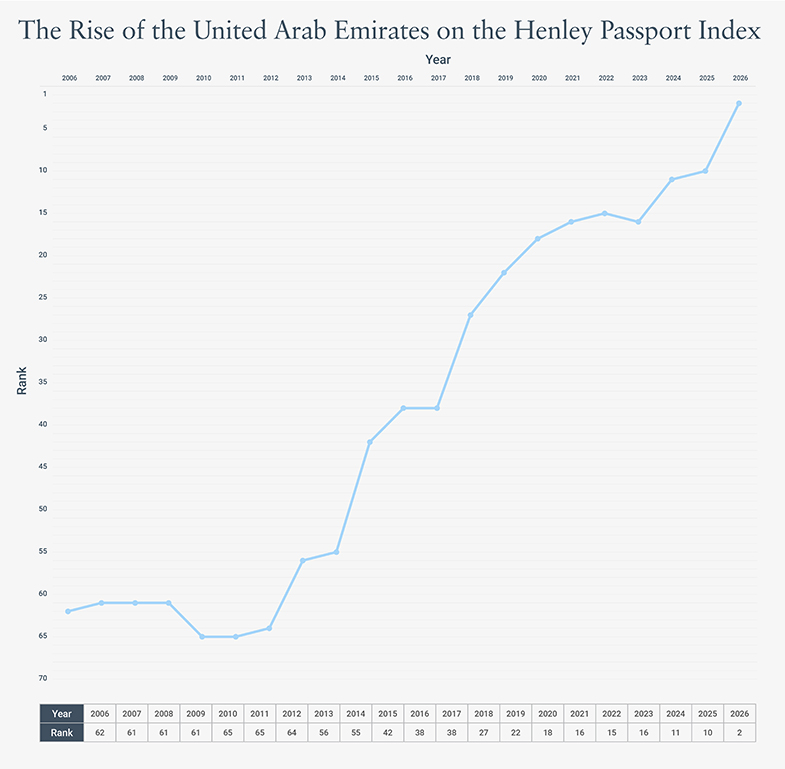
No country has transformed its passport more dramatically than the United Arab Emirates. Over two decades it added 153 visa-free destinations — the largest gain in Henley Passport Index history — rising from 62nd place in 2006 to joint 2nd globally in 2026 through sustained diplomatic engagement and an ambitious program of reciprocal visa-waiver agreements.
DownloadHenley & Partners assists international clients in obtaining residence and citizenship under the respective programs. Contact us to arrange an initial private consultation.